

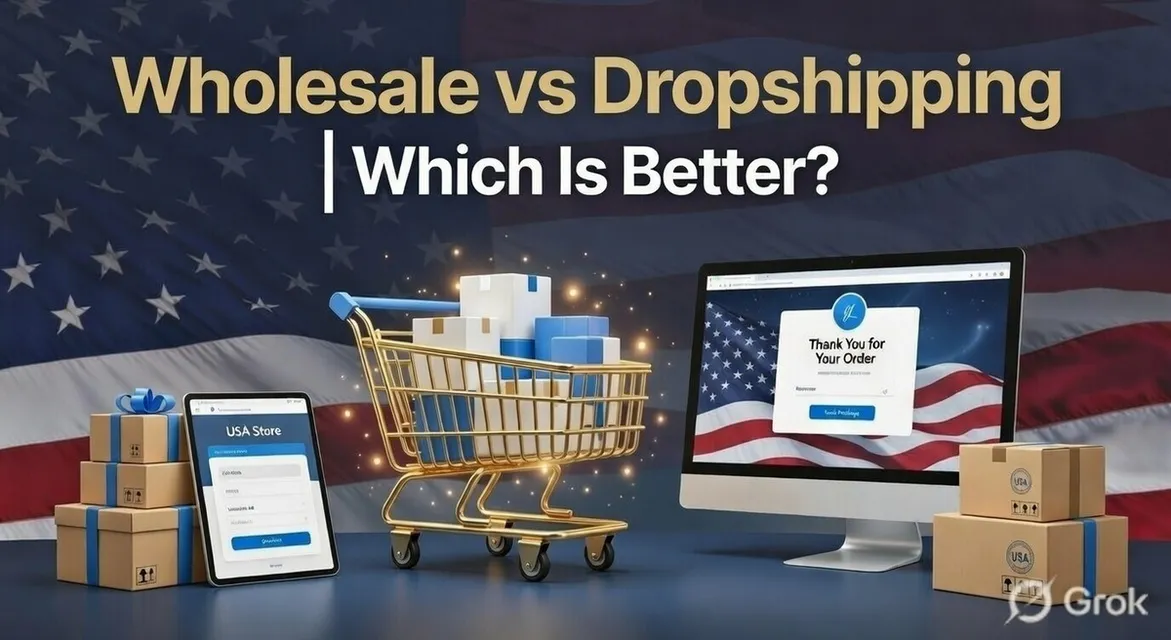
Wholesale vs Dropshipping: An Honest Comparison for US Sellers
If you're starting an ecommerce business or looking to add a new product line, you've probably asked yourself: should I buy wholesale or dropship? Both models can work — and both can fail spectacularly if you choose the wrong one for your situation.
This isn't a theoretical breakdown. We'll walk through the real numbers, the day-to-day reality of running each model, and help you figure out which one actually makes sense for where you are right now. No SaaS tool pitches, no affiliate links — just a practical comparison from someone who's seen both sides.
⚡ The 60-Second Version
You buy products in bulk upfront, store them yourself (or in a warehouse), and ship to customers. Higher margins (40–70%), full control over quality and shipping, but you need capital to start ($2K–$10K+) and risk unsold inventory.
You list products on your store and when a customer orders, the supplier ships directly to them. Zero inventory risk, start for under $500, but lower margins (10–25%), no quality control, and you're competing with thousands of other sellers listing the same products.
📊 Side-by-Side Comparison
Here's how the two models stack up across the factors that actually matter when running a business day-to-day:
| Factor | 📦 Wholesale | 🔄 Dropshipping |
|---|---|---|
| Startup Cost | $2,000–$10,000+ | $200–$500 |
| Profit Margins | 40–70% | 10–25% |
| Inventory Risk | Yes — unsold stock is your problem | None — you never hold inventory |
| Shipping Speed | 1–3 days (you control it) | 7–21 days (supplier-dependent) |
| Quality Control | Full — you inspect before shipping | None — you never see the product |
| Product Differentiation | High — custom packaging, bundling | Low — same products as competitors |
| Scalability | Scales with capital investment | Scales quickly but margins compress |
| Customer Experience | Strong — branded, fast, consistent | Weaker — generic packaging, slow |
| Best Platform | Amazon FBA, own website, retail | Shopify, eBay, own website |
| Time to First Sale | 1–3 weeks | 1–3 days |
💵 The Real Numbers: A $10,000 Revenue Scenario
Theory is nice, but what do the economics actually look like? Let's compare both models assuming you sell $10,000 worth of products in a month:
Cost of goods (40% of retail): −$4,000
Shipping to customers: −$800
Platform fees (~15%): −$1,500
Packaging & supplies: −$200
Storage costs: −$300
Net Profit: $3,200 (32%)
Cost of goods (70% of retail): −$7,000
Shipping (included by supplier): $0
Platform fees (~15%): −$1,500
Ad spend to drive traffic: −$1,200
Returns / chargebacks: −$400
Net Profit: −$100 (break-even)
🧭 Which Model Is Right for You?
Forget the "one is better than the other" debate. The right model depends entirely on your situation right now. Here's a decision framework based on real-world factors:
• Want to build a real brand with repeat customers
• Plan to sell on Amazon FBA (their fulfillment infrastructure makes wholesale incredibly efficient)
• Want higher profit margins and can handle some inventory management
• Have a specific product category in mind that you understand well
• Are thinking long-term (6–12+ months to build a sustainable business)
• Want to test product ideas quickly before committing money
• Are comfortable with lower margins in exchange for zero upfront risk
• Have strong marketing skills (ads, social media, content) to drive traffic
• Don't have physical storage space for inventory
• Are treating this as a learning experience to understand ecommerce before scaling
🏭 How to Find Wholesale Suppliers in the USA
If you've decided wholesale is right for you — or you're ready to transition winning dropship products to wholesale — here's where to find legitimate suppliers:
Clever Wholesale is a free directory of verified US wholesale suppliers and distributors covering clothing, electronics, beauty products, toys, food and grocery, pet supplies, and 40+ other categories. No membership fees, no paywalls — browse and contact suppliers directly.
Other sourcing channels include wholesale trade shows (like ASD Market Week and MAGIC), online B2B marketplaces (Faire, FashionGo), and direct manufacturer outreach. For a deeper dive into sourcing methods, read our complete guide to finding wholesale suppliers in the USA.
📦 What About Amazon FBA?
Amazon FBA is the best of both worlds for wholesale sellers. You buy products in bulk from wholesale suppliers, ship them to Amazon's fulfillment centers, and Amazon handles storage, picking, packing, shipping, and customer service. You get the margins of wholesale with the hands-off convenience that makes dropshipping attractive.
The downside is Amazon's fees (roughly 30–35% of the sale price). But even after fees, FBA wholesale sellers typically net 15–25% margins — significantly better than dropshipping. If wholesale interests you, Amazon FBA is worth exploring. Check out our Amazon FBA wholesale suppliers page for suppliers that specifically serve FBA sellers.
🔄 Transitioning from Dropshipping to Wholesale: A Step-by-Step Path
If you're currently dropshipping and want to move to wholesale for better margins, here's a practical roadmap:
Look at your last 90 days of sales data. Which 3–5 products generate the most revenue and have the most consistent demand? These are your wholesale candidates.
Browse the Clever Wholesale directory in the relevant product categories. Contact at least 5–10 suppliers, request pricing sheets, and compare MOQs.
Before committing to a bulk order, get samples from 2–3 suppliers. Compare quality, packaging, and turnaround time against what your dropship supplier has been sending.
Start with one product at the supplier's minimum order quantity. Sell through the inventory while continuing to dropship everything else.
As each product proves itself at wholesale margins, convert the next one. Within 3–6 months, your best products are all wholesale while you continue using dropshipping to test new ideas.
Frequently Asked Questions
Is wholesale more profitable than dropshipping?
Can I do both wholesale and dropshipping at the same time?
How much money do I need to start wholesale?
What are the risks of dropshipping?
Where can I find wholesale suppliers in the USA?
The Bottom Line
Dropshipping is a great starting point for learning ecommerce with minimal risk. But if your goal is to build a real, profitable business — one with healthy margins, happy customers, and long-term sustainability — wholesale is where the economics make sense. The smartest path for most sellers is to start lean (even with dropshipping), find what works, then move those winners to wholesale as fast as you can.
📌 Quick link: Business Services · Retail Supplies.
📌 Related reading: Wholesale Suppliers for Resellers USA | 2026 Guide · Wholesale Suppliers for Small Business USA · Best Wholesale Products to Sell USA · Section 321 De Minimis in 2027: What the Suspension Means for US Wholesale Importers and Suppliers · Sports Equipment and Fitness Gear: Profitable Wholesaling Strategies for US Dropshippers (2026 Guide).Continue exploring: How to Find Wholesale Suppliers in the USA.





Leave Comment Below