

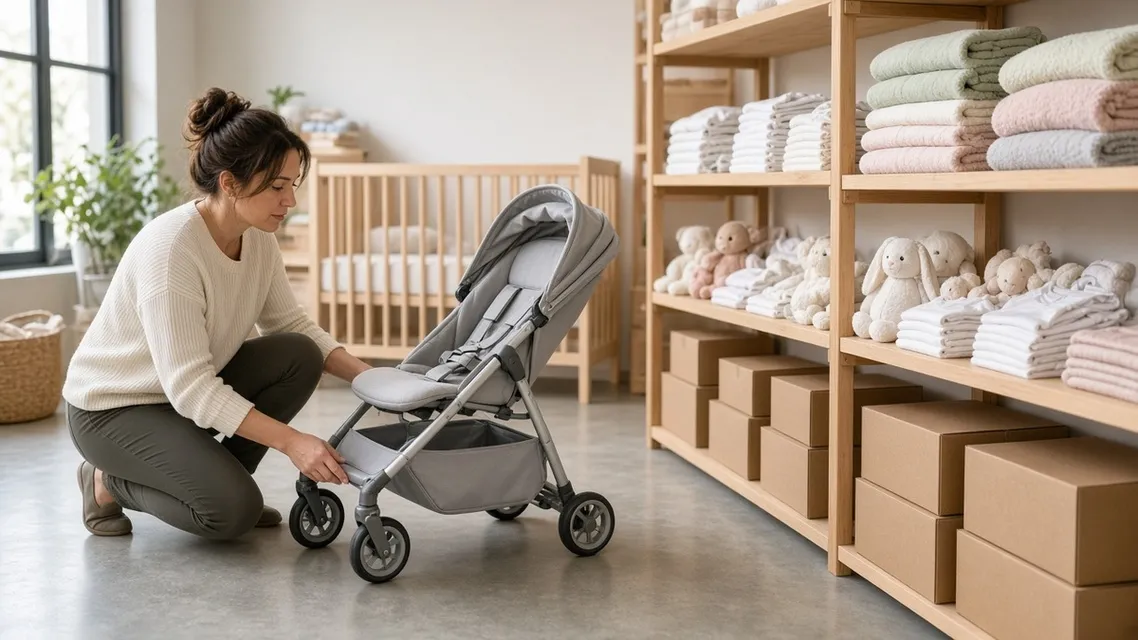
Baby products look like an easy wholesale category: every family needs them, customers come back as the child grows, and gifts for showers and first birthdays keep demand steady all year. In practice it is one of the most regulated and most tariff-exposed categories a US retailer can stock. The CDC's National Center for Health Statistics counted 3,606,400 US births in 2025, down 1% from 2024, so the customer base is large but not growing. At the same time, parents are feeling prices: in the RAPID Survey Project's October 2026 fact sheet, 39% of surveyed parents said the cost of infant and toddler equipment had risen over the previous year.
This guide is for baby boutiques, gift shops, children's clothing stores, pharmacies, general merchandise retailers and online resellers who want to buy wholesale baby products in the US. It explains the supplier types you will meet, which products are easiest and hardest to stock, what the late-2026 US-China tariff news really means for car seats, strollers and high chairs, and the federal safety rules every seller of baby goods must follow. If you also stock toys or kids' apparel, read it alongside our wholesale toys sourcing guide and our wholesale clothing suppliers guide.
📌 Quick link: Browse baby suppliers on Clever Wholesale: Baby Care · Baby Clothing · Baby Toys · Baby Furniture · Strollers and Baby Transporters.
Who Sells Baby Products at Wholesale in the USA
There is no single Census classification for baby goods. Baby clothing sits with apparel distributors under NAICS 424350, Clothing and Clothing Accessories Merchant Wholesalers, while gear, furniture, toys and consumables are spread across furniture, toy, drug and general merchandise wholesalers. For a buyer, the useful split is by how the supplier sells.
| Supplier type | What they offer | Typical buyer | Watch out for |
|---|---|---|---|
| Brand wholesale accounts | Current strollers, car seats, carriers, feeding and nursery lines direct from the brand or its US distributor, with marketing assets and warranty support | Specialty baby stores and established online shops | Account approval, opening minimums, MAP (minimum advertised price) policies and limits on marketplace selling |
| Independent reps and agencies | Several juvenile and gift brands in one territory; they write orders in-store and at trade shows | Boutiques and gift shops that want to see product before ordering | Pre-book timing and seasonal order windows |
| Distributors and importers | Their own labels or licensed lines from a US warehouse, often in smaller case packs: bibs, blankets, bottles, bath, layette and soft toys | Gift shops, pharmacies, general stores and online sellers | Case packs that force colors or sizes you do not want; ask who holds the Children's Product Certificate |
| Private label manufacturers | Your own design or a modified factory design, usually made overseas | Retailers with volume and a clear brand idea | You become the importer and the certifier, with testing, eFiling and registration-card duties |
| Closeout and off-price sellers | Discontinued colors, packaging changes, overstock and customer returns, often by the case or pallet | Off-price stores and online resellers | Recalled, banned or incomplete items; missing manuals and registration cards |
Most independent baby stores mix two or three of these: a few brand accounts for the strollers and car seats customers ask for by name, a distributor for soft goods and gifts, and occasional closeouts for promotions. Our guide to B2B wholesale suppliers, trade accounts and net terms explains how to open accounts and negotiate terms with each supplier type.
What Sells: Baby Product Categories Compared
Baby products range from low-risk soft goods to heavily regulated gear. The table below is a practical way to decide where to start. The regulatory notes come from the federal rules covered later in this guide.
| Category | Examples | Why retailers stock it | Buying difficulty |
|---|---|---|---|
| Baby clothing and layette | Bodysuits, sleepers, hats, socks, swaddles | Repeat purchases as children grow; strong gift demand | Low to medium: size curves, lead and flammability rules for some items |
| Gifts and keepsakes | Blankets, memory books, rattles, plush, gift sets | Shower and holiday gifting; good margins at gift shops | Low to medium: small parts and labeling for anything a baby can handle |
| Feeding and bath | Bottles, bibs, teethers, bath seats, tubs | Consumable and replacement demand | Medium: phthalate limits on child care articles; bath seats and tubs are durable infant products |
| Baby toys | Soft toys, activity toys, stacking toys | Year-round gifting and impulse buys | Medium: toy standard, small parts and third-party testing |
| Nursery furniture | Cribs, bassinets, changing tables, gliders | High ticket, high loyalty | High: mandatory standards, registration cards, freight and damage risk |
| Strollers, carriers and car seats | Strollers, wagons, infant carriers, car seats | High ticket and strong brand pull | High: mandatory standards, recall exposure, tariff swings; car seats also fall under NHTSA rules |
A new store usually does best starting with clothing, gifts and soft toys from baby clothing suppliers and baby toy suppliers, then adding gear lines once it has the space, the staff knowledge and a recall process. For online merchandising ideas, see our earlier piece on e-commerce strategies for baby products.
Tariffs in Late 2026: What the US-China Board of Trade List Means
Most baby gear sold in the US is still made in China, which is why trade policy matters so much in this category. On September 27, 2026 the White House published the U.S.-China Board of Trade "30-for-30" lists: roughly $30 billion of goods each way recommended for reduced tariff treatment. The US import list of 77 tariff lines includes several baby lines, but not all of them.
| Product | On the US list? | Notes |
|---|---|---|
| Highchairs, booster seats, bath seats, infant walkers, bouncers and swings | Yes (HTS 9401.71, 9401.79, 9401.80, partial lines) | Listed as "ex-outs", meaning only the described part of each tariff line qualifies |
| Child safety (car) seats | Yes (HTS 9401.80.60, partial line) | Car seats must also meet the federal motor vehicle standard |
| Play yards and enclosures for children, of plastics | Yes (HTS 9403.70.40 and 9403.70.80, partial lines) | Plastic play yards only |
| Toys, excluding Wi-Fi, Bluetooth and other connected toys | Yes (HTS 9503.00.00, partial line) | The Toy Association says toys are the largest category on the list |
| Strollers and baby carriages | No | Not on the list; check current duty under HTS 8715 |
| Cribs and other wooden nursery furniture | No | Only the plastic play yard lines are listed |
Being on the list is not the same as a tariff cut. U.S. Trade Representative Jamieson Greer said reductions cannot happen until a Section 301 public comment process is complete, as reported by International Trade Today on September 30, 2026, and the Toy Association noted in October that timing details had not been released. A Lighthill PC client alert made the same point: the lists set no rates and no effective date. Most recently, the Sandler, Travis & Rosenberg trade report of November 20, 2026 said the Board of Trade had held its first official meeting, but that USTR has since clarified the list is not slated for immediate cuts; instead the US is pledging not to raise tariffs on those goods in future trade actions.
What that means for your buying
- Do not price in a cut yet. Cost your 2027 orders on today's duties, and treat any reduction as upside.
- Ask suppliers if prices are duty-paid. A quote that is "DDP" (delivered duty paid) moves the tariff risk to the supplier; an FOB quote leaves it with you.
- Watch strollers and cribs closely. They are not on the list, so they carry the most price risk in 2027.
- Check the code, not the product name. Look up the exact line in the official Harmonized Tariff Schedule; the ex-out wording on the list is narrow.
The Safety Rules Every Baby Product Seller Must Know
Baby products are children's products under federal law, and the US Consumer Product Safety Commission (CPSC) enforces strict rules. Retailers are not the certifier when they buy from a US importer, but they are still prohibited from selling non-compliant or banned products, so it pays to know what to ask for.
Children's Product Certificates and third-party testing
Products designed mainly for children 12 and under that are subject to a children's product safety rule need a Children's Product Certificate (CPC), based on testing by a CPSC-accepted third-party lab. Federal law, restated in CPSC's 2025 certificates rule, requires that a copy of the certificate be furnished to each distributor or retailer of the product, so ask for it before your first order.
eFiling for imports since July 8, 2026
If you import baby products yourself, the rules changed this year. Since July 8, 2026, importers must electronically file certificate data with CBP at entry for regulated consumer products, either with each shipment or by referencing records stored in CPSC's Product Registry. Products entered from a Foreign Trade Zone follow from January 8, 2027, according to CPSC's certificates guidance. Retailers buying from a US distributor are not filing, but a distributor that cannot explain its eFiling process is a warning sign.
Lead, phthalates and durable infant products
- Lead: children's products may not contain more than 100 ppm of total lead in accessible parts.
- Phthalates: children's toys and child care articles (products for sleeping, feeding, sucking or teething for children 3 and under) may not contain more than 0.1% of the regulated phthalates in accessible plasticized parts.
- Registration cards: 16 CFR Part 1130 requires a postage-paid consumer registration card on durable infant and toddler products such as cribs, high chairs, strollers, play yards, bath seats, carriers, swings and bouncers. Missing cards are common in returns and closeout lots.
- Car seats: child restraint systems must meet Federal Motor Vehicle Safety Standard 213, enforced by NHTSA.
Banned products
Under the Safe Sleep for Babies Act, it has been unlawful since November 12, 2022 to sell, distribute or import inclined infant sleepers and padded crib bumpers, no matter when they were made. These still turn up in liquidation pallets and marketplace listings, so screen every lot.
Pricing, Minimums and Margins
Baby suppliers price in different ways depending on the category. Soft goods and gifts are often sold by the case pack (for example, six of one style across a size run), with modest opening orders that suit small shops. Gear brands more often set an opening order value, a minimum number of units per style, and MAP rules that limit how low you can advertise. Ask every supplier these questions before you commit.
| Question | Why it matters |
|---|---|
| What is the opening order minimum, and the reorder minimum? | Many brands ask more on the first order than on reorders |
| Is there a MAP policy, and does it cover marketplaces? | MAP protects your margin but may limit discounting and online channels |
| Who handles warranty claims and recalls? | Gear buyers expect help when something breaks or is recalled |
| Are prices duty-paid, and when were they last updated? | Tariff changes in 2026 have moved landed costs several times |
| Can I get a CPC and test reports for each item? | You need these to answer customer and marketplace questions |
| Do you accept a resale certificate? | Most states let you buy for resale without paying sales tax with the right certificate; the Multistate Tax Commission's uniform certificate is accepted in many states |
Closeouts, Returns and Liquidated Baby Products
Off-price baby lots can be profitable, especially clothing, bedding and feeding items in discontinued colors. Gear is a different matter. CPSC's Resellers Guide to Selling Safer Products reminds resellers that it is illegal to sell recalled products, and that includes second-hand and returned items. Before buying a lot, ask for a manifest by item and model number, check models against CPSC recall notices, and avoid used car seats, cribs and anything without its manual, labels and registration card. Our full guide to buying closeouts, pallets and overstock covers manifests, grading and how to judge a lot.
Trade Shows for Baby and Juvenile Buyers
The main US event for this category is the ABC Kids Expo, described by its organizer as North America's B2B juvenile products expo. The 2027 show runs May 12 to 14, 2027 at Mandalay Bay Resort and Convention Center in Las Vegas, is open to industry professionals only, and attendee registration opens in January 2027. Gift and toy markets are also useful for baby soft goods and gifts; our toys guide lists the main toy and gift shows.
How to Vet a Baby Products Supplier
- A real business address, phone number and a sales contact who can answer safety and warranty questions.
- A Children's Product Certificate and recent third-party test reports for every children's item you buy.
- Proof of authorization if they sell a brand they do not own, especially for car seats and strollers, where counterfeits are a real risk.
- Clear written terms on minimums, defects, returns, freight and recall handling.
- For imports: the country of origin, the HTS number used, and how they handle eFiling and registration cards.
- References from other retailers, or a listing on a reputable wholesale directory.
Start with the Baby Care category on Clever Wholesale to shortlist suppliers, including nursery furniture and stroller and baby transporter suppliers, then follow our step-by-step guide on how to find wholesale suppliers in the USA. For more places to look, see our list of the 15 best wholesale directories in the USA.
Frequently Asked Questions
Do I need a license to buy wholesale baby products?
Most suppliers ask for a business registration and a state sales tax permit or resale certificate before opening a trade account. Requirements vary by state, so check with your state tax agency.
Is it safe to sell used or returned baby gear?
Only with great care. It is illegal to sell recalled products, and inclined sleepers and padded crib bumpers are banned outright. Many retailers avoid used car seats and cribs entirely and stick to new or unworn soft goods.
Will tariffs on car seats and high chairs go down in 2027?
They might, but nothing has changed yet. Car seats, highchairs and some other baby lines are on the September 2026 US-China list, but USTR has said any cut needs a public comment process, and in November 2026 it described the list mainly as a pledge not to raise tariffs on those goods. Strollers and cribs are not on the list.
What paperwork should a baby products wholesaler give me?
At minimum, a Children's Product Certificate for each children's product, plus test reports on request. Durable infant products should arrive with registration cards, and car seats should carry the labels required under FMVSS 213.
What is the easiest baby category for a new store?
Baby clothing, blankets, gift sets and soft toys are usually the easiest place to start: lower minimums, smaller freight and fewer warranty issues than strollers, car seats or furniture.
When is the ABC Kids Expo in 2027?
May 12 to 14, 2027, at Mandalay Bay Resort and Convention Center in Las Vegas. It is a trade-only event, with registration opening in January 2027.
Related Reading
- Wholesale Toys USA: A 2026 Sourcing Guide for Toy Stores, Gift Shops and Resellers
- Wholesale Clothing Suppliers USA: The Complete 2026 Sourcing Guide
- Strategies for E-Commerce Success in the Online Market for Baby Products
- How to Find Wholesale Suppliers in the USA
- 15 Best Wholesale Directories USA (Free & Paid)
- Wholesale Liquidation: How to Buy Closeouts, Pallets and Overstock
- B2B Wholesale Suppliers USA: Trade Accounts and Net Terms
Last updated: November 21, 2026. Birth data are from CDC NCHS provisional 2025 figures (April 9, 2026). Parent cost data are from the RAPID Survey Project fact sheet (October 2026). Tariff list details are from the White House U.S.-China Board of Trade release and US Public List (September 27, 2026), International Trade Today (September 30, 2026), the Toy Association (October 5, 2026), Lighthill PC (October 5, 2026) and Sandler, Travis & Rosenberg (November 20, 2026). Safety rules are from CPSC guidance, 16 CFR Part 1130 and 49 CFR 571.213. ABC Kids Expo dates are from the organizer and may change. This is general information, not customs, tax, legal or product safety advice.




Leave Comment Below